RESEARCH

We study quantum effects in optically active nanoscale solid state systems. The optical spectrum of a semiconductor nanosystem is conceptually similar to that of atoms or ions: spatially localized electrons reside in discrete states with quantized energy, angular momentum and spin degrees of freedom that directly map onto photons in absorption or emission, rendering optical spectroscopy a powerful tool for fundamental studies.


Self-assembled Quantum Dots

Self-assembled InGaAs quantum dots embedded in a GaAs matrix represent an advanced solid state system for the study of quantum optical phenomena in nanostructured semiconductors. In field-effect devices we control the doping of quantum dots down to the elementary charge and use resonant lasers to induce quantum dot excitations. We advance techniques for coherent preparation, manipulation and readout of quantum dot charge and spin states with the focus on coherent spin physics and effects of coupling between the quantum dot electron and nuclear spins.

Colloidal Quantum Dots

We study II-VI compound semiconductor nanocolloids such as CdTe/CdSe or CdSe/CdS/ZnS quantum dots. Colloidal nanoparticles exhibit strong dependence of their spectral signatures on size and material composition: crystalline symmetry, nanocrystal shape and electron confinement can be tailored according to the principles of heterostructure design to modify the optical spectrum. In our studies we use high-quality colloidal quantum dots free of blinking, bleaching and spectral wandering with the emphasis on magneto-optical phenomena of single and multiple excitons. Our collaboration partner in the project is the group of E. Lifshitz, Technion - Israel Institute of Technology, Haifa, Israel.

Carbon nanotubes

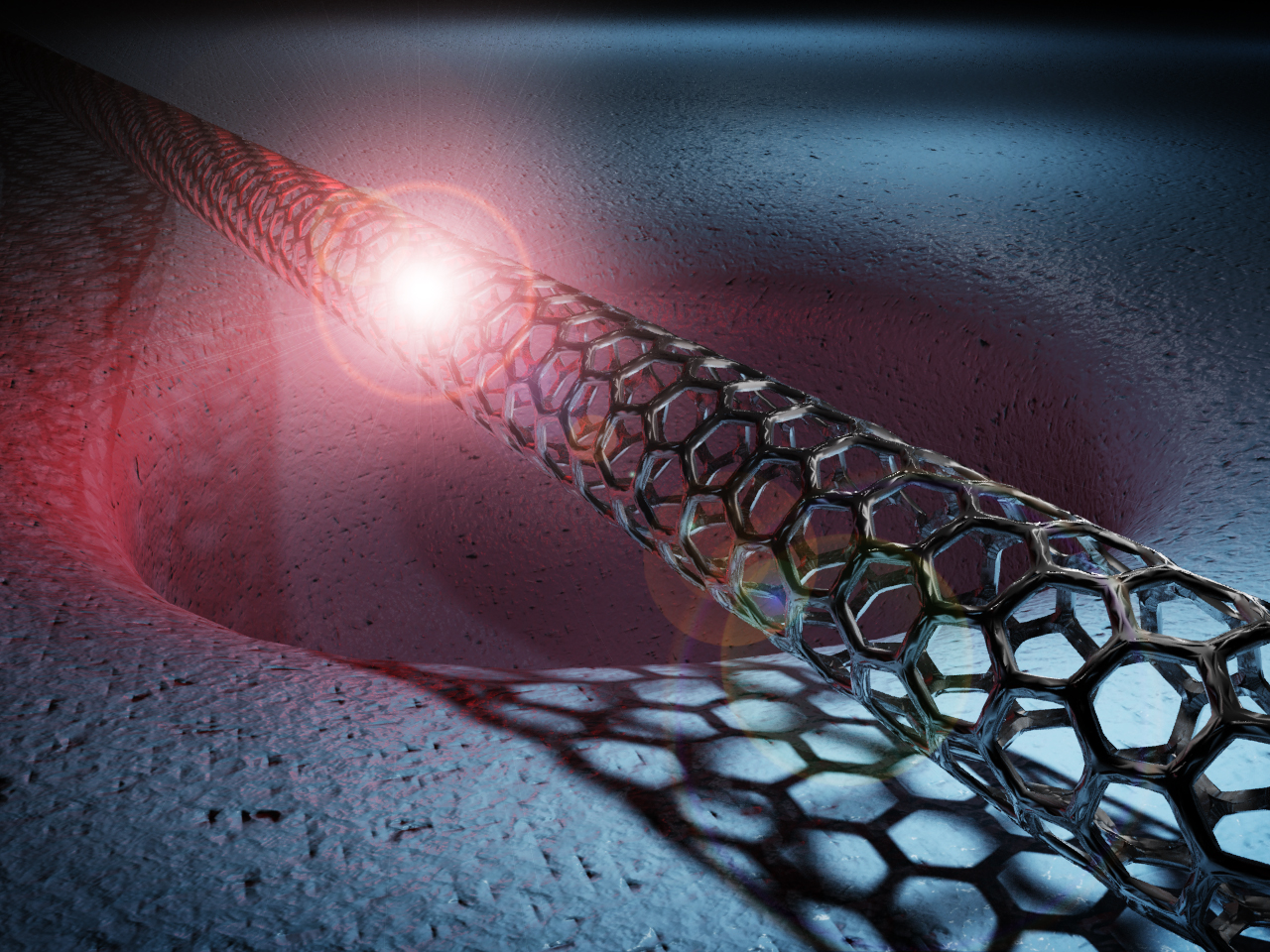
Optical emission from semiconducting single-wall carbon nanotubes covers a broad spectral window from visible to infrared. When cooled down to cryogenic temperatures, single carbon nanotubes show photon emission statistics that are characteristic of quantum emitters: they emit merely one photon at a time. The underlying mechanism that ensures single photon emission is strong carrier localization along the nanotube axis - the manifestation of a carbon-based quantum dot. We develop both spectroscopy techniques and carbon nanotube devices that allow to study spin phenomena in carbon nanotube quantum dots.

Photonic architectures with DNA-origami

This interdisciplinary research project aims at exploring the potential of DNA-assembly for the construction of complex networks with photonic functionality. It merges recent achievements in biophysics and solid state nanosciences for DNA-guided fabrication of functional components based on colloidal quantum dots and metal nanoparticles. The goal of the project is to establish fundamental tools for bottom-up nanometer-precise assembly of rudimentary photonic systems and complex photoactive networks. Our collaboration partners in the project are the groups of T. Liedl, LMU, and A. O. Govorov, Ohio University, Athens, USA.

Spin-resolved spectroscopy of mesoscopic systems

We are aiming at developing generic all-optical spin detection methods for studies of mesoscopic transport systems. While it is challenging to access the spin degree of freedom in conventional transport experiments, optical methods could successfully exploit the correspondence between electron spin and photon polarization. We use this approach to investigate the regime of the 0.7-anomaly in a quantum point contact. Recent theory work relates the 0.7-anomaly in the conductance of a quantum point contact to the same microscopic origin as the Kondo effect in a quantum dot: both arise from a subtle interplay of spin and interaction effects. Our collaboration partners in the project are the groups of J. von Delft and S. Ludwig, LMU.

Quick Links